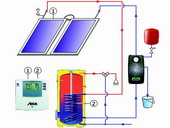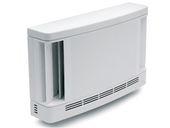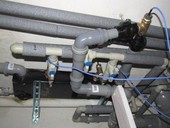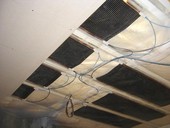
In the previous article we described our decision-making process. At the end of this process we decided to install electric radiant ceiling heating panels. In this article you can read how we have realized it.
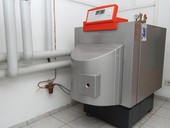
The paper presents an example of solving the propagation of noise from an air/water heat pump installed in the basement of an apartment building. Air intake and exhaust are brought out on the façade of the building, where it is calculated the noise situation in the protected exterior of the building. In the interior it is solved the propagation of sound from the plant room to the protected interior space. In conclusion, the results are compared with the data from the report on measurement at the realized work.

For more than a year, a nearly zero-energy standard has applied to certain buildings. In the Czech environment, specific technical parameters for such buildings have been known for three years. And for over six years, the Directive on energy performance of buildings has been in force, imposing the obligation upon EU member states to introduce this standard.
Nevertheless, it seems that for many experts, including those in the field of energy, this term is still quite unclear. Many imagine buildings coated with photovoltaic modules from the ground to the roof, buildings which are better than passive ones or buildings which are self-sufficient, i.e. completely independent of public energy networks. Given the fact that the concept of a nearly zero energy building is very distant from such notions, and because this standard will soon become obligatory for all buildings, including small family houses, let's have a look at what a nearly zero-energy building really is.
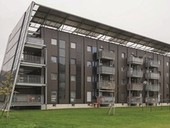
The article describes the impact of the contemporary and future legislative requirements for new buildings in terms of their conception and utilization of renewable resources. Soon, the requirement of quality standard is going to be effective in the Czech Republic that is called building with nearly zero energy consumption. That quality standard is defined at national level by legal regulations based on the requirement of European standard. On examples of family house, residential house and administration building, the impact of the to-be-established requirements for building conception is being demonstrated from the construction as well as the technical systems' point of view. With the existing development trend maintained it can be expected that a building with nearly zero energy consumption will have, comparing to an existing building, a better quality building shell, technical systems working with high efficiency and potentially may but needn't be, partially supplied by renewable energy resources.
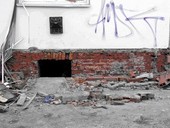
Taking into account the experience and results of the investigation of certain events on the gas and associated facilities (fire, explosion, poisoning, fumes, prohibited manipulation, etc.) from the perspective of a forensic expert we have prepared material, which will be published on the continuation. Contents of this material is based on real cases. Material according to the extent of individual reported cases includes:
The purpose of the material is to highlight the potential risks when designing, installing, testing, inspecting, maintening and operating of gas and associated equipment and also to identify possible breaches of regulations and procedures in everyday practice.
Individual cases are accompanied by photographs, measurements and in some cases by used calculations.
The material will be regularly complemented by other practical cases.
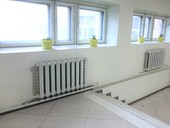
Currently, it is common to design the heating system such as two-pipe. Automated computing programs contribute to this trend that other variants can not even rule. But for some buildings is single pipe system from the perspective of operation suitable and due to lower material intensity even better preferable. The author demonstrates this on specific example of a two-floor family house.
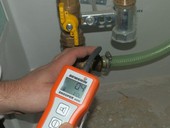
Taking into account the experience and results of the investigation of certain events on the gas and associated facilities (fire, explosion, poisoning, fumes, prohibited manipulation, etc.) from the perspective of a forensic expert we have prepared material, which will be published on the continuation. Contents of this material is based on real cases. Material according to the extent of individual reported cases includes:
The purpose of the material is to highlight the potential risks when designing, installing, testing, inspecting, maintening and operating of gas and associated equipment and also to identify possible breaches of regulations and procedures in everyday practice.
Individual cases are accompanied by photographs, measurements and in some cases by used calculations.
The material will be regularly complemented by other practical cases.
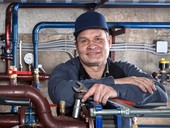
Operators of boilers and heaters, solid fuel for power from 10 to 300 kW, connected to a hot water heating system, left last month in order to secure the obligatory checking its source authorized person (if not already). Perhaps the biggest problem are false inspectors who at the gullible and "ignorant" operators carry out checks without having to be entitled. Thus, the inspections carried out are usually cheaper than controls carried out by an authorized person, but from the perspective of the law are invalid.
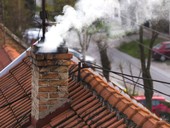
The European Parliament approved November 23, 2016 the new limits for selected emissions and air pollutants. For Member States resulting from this new commitments to reduce certain emissions in two stages - from 2020 and from 2030. For the Czech Republic based on commitments to the middle threshold in comparison to the commitments of other EU members. Prescribed emission reductions will be mainly sulfur dioxide, nitrogen oxides, ammonia emissions and fine particulate matter (airborne dust).
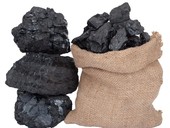
The article describes the role of coal in the segment of small household heating heat source. Support of brown coal boilers in the framework of subsidies from European funds is in full swing, but many of these boilers failed to comply with the European Commission.
On the other hand, there are mechanisms by which the Czech Republic wants significantly reduce the burning of brown coal in small combustion sources in the foreseeable future. It is most often quoted Czech against-fossil law, but it is not alone one.
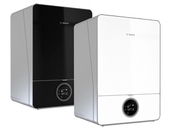
The introduction of stricter Ecodesign requirements for products associated with the consumption and production of energy is related to a smooth transition to the use of gas condensing boilers. In practice, exchanges of old boilers meet incorrect interpretation and perceptions about the benefits of condensing boilers. The article therefore assesses the impact of condensation theory and measurement and answers some practical issues.
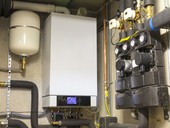
Taking into account the experience and results of the investigation of certain events on the gas and associated facilities (fire, explosion, poisoning, fumes, prohibited manipulation, etc.) from the perspective of a forensic expert we have prepared material, which will be published on the continuation. Contents of this material is based on real cases. Material according to the extent of individual reported cases includes:
The purpose of the material is to highlight the potential risks when designing, installing, testing, inspecting, maintening and operating of gas and associated equipment and also to identify possible breaches of regulations and procedures in everyday practice.
Individual cases are accompanied by photographs, measurements and in some cases by used calculations.
The material will be regularly complemented by other practical cases.
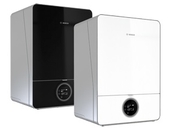
The introduction of stricter Ecodesign requirements for products associated with the consumption and production of energy is related to a smooth transition to the use of gas condensing boilers. In practice, exchanges of old boilers meet incorrect interpretation and perceptions about the benefits of condensing boilers. The article therefore assesses the impact of condensation theory and measurement and answers some practical issues.
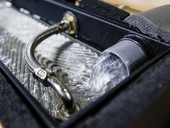
The article deals with possibilities of using heat from waste water discharged by outlet pipes of house appliances. The first section describes the basic possibilities of the local heat recovery (recuperation), used mainly in showers and shower baths. Theoretical analysis of the efficiency and related achievable savings is supported by an experimental measurement of a selected type of recuperative heat exchanger. The results of the measurement are compared with the classification according to the Passive House Institute. In addition to the efficiency and energy savings achieved by deploying the recuperative heat exchanger, the economic return of the specific heat exchanger is also determined for different boundary conditions.
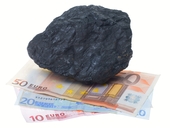
Coal prices in Europe rose during 2016 by a staggering 69%. Coal producers suffer from the decreasing demand and are forced to reduce mining. It fell by 10%. Direct response is an increase in coal prices. It can be expected that the coal industry will continue to decline and the forehead will receive renewable energy sources. In renewables has already begun to invest in China. The rise in the price of coal should count and households.